
A Note from Cece Clark, Investor Relations:
“Hey everyone,
As I’ve been talking with both our long-standing members and new faces looking to join the BACH community, a common question comes up: ‘What makes the BACH model so different from traditional real estate funds?’
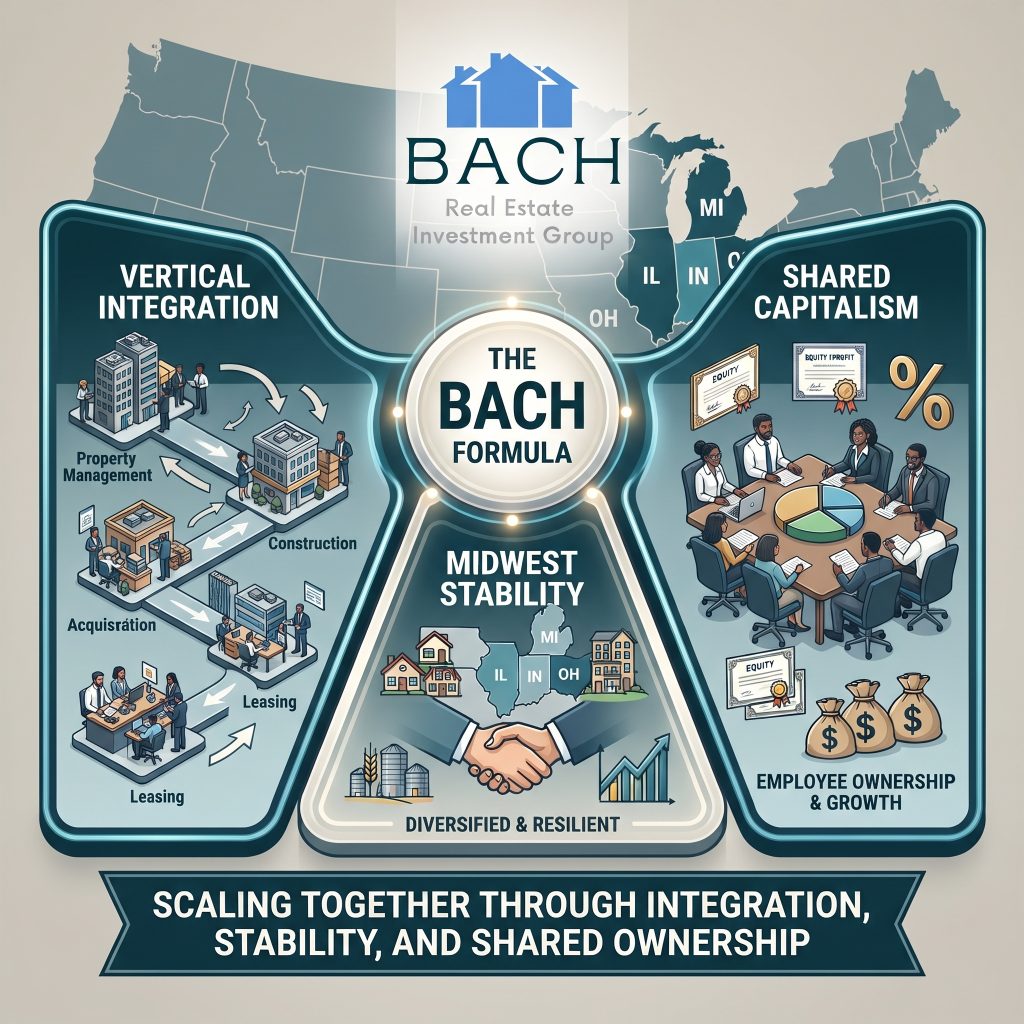
A few weeks ago, an investment podcast host based out of Florida reached out to us. They had been tracking our growth, looked closely at our website, and wanted to get Derrick on a show to pull back the curtain on our operations. They wanted to know how a Midwest-based firm is quietly outperforming volatile Sunbelt trends and how we’ve built an ecosystem where the members actually share in the corporate upside.
It was such a powerful, transparent conversation that I wanted to make sure every single member of our group had access to it. I grabbed the transcript of the interview so you can read exactly how Derrick views our scaling strategy, our internal systems, and where we are taking BACH next (including our roadmap toward an institutional IPO).
Lets dive into the transcript below to see the exact blueprint of what you are a part of!”
Part 1: Breaking the Double-Digit Ceiling
Host: Welcome back to the show. Today, we are taking a trip up to the Midwest—virtually, at least. Down here in the hyper-competitive, fast-paced Florida market, we hear a lot of noise about the Sunbelt. But every seasoned investor knows that real wealth is often built quietly where the foundations are rock-solid.
Our guest today is the founder of BACH Investment Group. He has scaled a massive residential portfolio, completely flipped the script on traditional property management, and is building a unique ecosystem centered around shared capitalism. Joining us from Decatur, Illinois, welcome to the show.
Derrick: Glad to be here. Thanks for having me.
Host: Let’s dive right into the reality of scaling. A lot of investors get stuck. They buy three, four, maybe five houses, and then they hit a wall. In your journey, when did the cracks first start to show, and how did you push past them?
Derrick: The real friction actually starts much earlier than people think—right around the double-digit mark. When you hit about 12 properties, the entire solo operation gets incredibly tough. Up until that point, you’re usually doing everything yourself: taking the calls, managing the turns, fixing the leaks.
At 12 units, you run face-first into a cash flow bottleneck. I solved that initial constraint with bank financing, but the bigger shift was mental. You have to decide what your actual role is going to be and start finding the right people to help handle the rest.
Host: And that friction shifts as you grow, right? What changes between 10 properties and 100 properties?
Derrick: The math changes completely. If you own 10 properties, you might see a few plumbing issues a year, but you rarely deal with major structural overhauls like roofs. But when you scale to 100 properties, the law of averages catches up to you.
If a standard roof lasts 30 years, owning 100 properties means you are mathematically replacing an average of three roofs every single year. There is always a roof that needs to be replaced.
The Scaling Insight: Because the volume of maintenance becomes constant at scale, outsourcing everything to third parties eats your entire margin. To control overhead—which is the ultimate bane of most real estate companies—we chose to internalize our services and learn how to self-perform. That is the key to protecting investor yields.
Part 2: Systems, Overhead, and the Speed of Execution
Host: Internalizing maintenance is a massive undertaking. How did you build out the systems to support that without drowning in chaos?
Derrick: It was a learned process born out of necessity. Every time a new problem arose, we didn’t just look for a quick fix; we figured out how to handle that task internally and built a repeatable system around it. Once we solved a problem, we proactively expanded the system to catch future variations of that same issue.
Take accounting and tax returns, for example. As the portfolio grew, the sheer volume of paperwork made it obvious that standard external accounting wasn’t going to cut it.
Host: How did you restructure that department?
Derrick: We brought the entire operation in-house. We invested in specialized software that allowed us to run multiple corporate returns efficiently. More importantly, we brought on an internal CPA who actively reviews financials and stays deeply involved in our yearly audits, working shoulder-to-shoulder with our designated bookkeeper.
It certainly saved money by slashing outside professional fees, but the real victory was speed and efficiency. We achieved both through a single, tightly implemented system. Building those operational engines is what I truly love to do, and I realized early on that this was the highest and best use of my time as a founder.
Part 3: The Midwest Advantage vs. The Florida Boom
Host: Being based down here in Florida, I see a ton of transience. People move in, people move out, rents spike, and turnover is high. You’ve kept your focus rooted in the Midwest. Contrast the two strategies for us.
Derrick: Investment strategies must adapt to the geography. The Midwest is a completely different animal compared to a market like Orlando.
In Orlando, you deal with a highly transient tenant base—short-term renters, vacation properties, or multiple singles sharing a house who might work seasonal jobs at the theme parks. High turnover means high make-ready costs, which drains profits.
In a market like Decatur, we see long-term, stable families. They anchor into the community, stay for years, and treat the property like a home. That stability creates predictable, resilient cash flow.
Host: Which is exactly why diversification matters.
Derrick: Exactly. No single market holds all the answers, which is why investing with a group like BACH is so valuable. There is a critical need to spread out your real estate footprint. Our ultimate goal is to expand this stable, systemized infrastructure all over North America, allowing members to participate in diverse market dynamics without having to manage the local headaches themselves.
Part 4: Re-Engineering Capitalism Through Shared Wealth
Host: Let’s talk about funding that growth. You’ve utilized both traditional bank capital and private investor capital. How did that transition change the trajectory of the business?
Derrick: Bank capital served its purpose early on, but the growth exploded when we opened up the ecosystem to shared investor capital.
I fundamentally believe the world is a better place when we share the fruits of our labor and work closely with our fellow man. There is absolutely room within capitalism for a collaborative, shared mentality.
As the BACH membership grows, we aren’t just aggregating capital; we are aggregating great minds. That network effect is incredibly powerful. In fact, I’ve actually started and purchased several other companies alongside talented BACH members I met through this group. When you treat people right and share the upside, the rewards are exponential—even though traditional business models teach the exact opposite. It really comes down to the company you keep.
Host: You’re also taking this asset protection structure to a pretty sophisticated level with trusts, aren’t you?
Derrick: We are taking it to a completely new level. This year, we completed the first stage: creating a robust master trust structure that cleanly holds and navigates our assets.
But the future plan isn’t just to protect my own family; it’s to turn this vehicle into a launchpad for other entrepreneurs. I want to provide a mechanism and a suite of foundational resources for people who want to tap into that American spirit, step out on their own, and build a business.
Part 5: The Ultimate Exit Strategy: Making Yourself Obsolete
Host: If an independent investor wants to position their portfolio for a major institutional exit or an acquisition, what is the number one thing they need to focus on?
Derrick: They need to focus on making themselves completely obsolete. The business must be engineered to run seamlessly with backups, and backups for the backups.
This is exactly where independent investors can merge their portfolios into BACH. They can instantly plug into our entire existing infrastructure without losing their momentum. They keep providing value to the broader operation, maintain their yearly income, and when BACH moves toward an IPO, they capture the exact same equity lift as every other member of the group.
Part 6: Human Centricity and the Entrepreneurial Spirit
Host: You have a very distinct view on operational technology. You aren’t a fan of total automation. Why?
Derrick: The human element should never go away. In my view, there are two distinct types of technology: tools that make you smarter, and tools that make you dumber.
Think of it as cognitive extension versus pure cognitive offloading. A calculator makes you smarter because it eliminates tedious manual computation, freeing your mind to focus on high-level strategy. On the flip side, relying entirely on GPS mapping software can cause our natural ability to navigate and understand directions to wither away.
We use technology strictly to enhance our productivity and act as a force multiplier for our people, never to fully replace the human relationships at the core of the business.
Host: How does that philosophy translate to your team culture? When you are hiring for key roles, what are you looking for?
Derrick: I don’t look for traditional employees; I look for people with the spirit of an entrepreneur. Because the BACH system is designed to allow team members to become true owners, I want peers who possess that ownership mindset.
At this stage in my life, I want shoulder-to-shoulder, peer-to-peer relationships instead of a top-down, boss-and-employee dynamic. I want to walk a path with partners who stand to gain directly when the company gains.
I’ve had a very fortunate life, and I genuinely enjoy what I do. Helping empower others to better their lives is incredibly fulfilling to me. Me doing well in the process is just a bonus.
Part 7: Protecting Time and Fighting Greed
Host: With so many moving parts, how do you manage to protect your own time and maintain boundaries?
Derrick: It loops right back to that peer-to-peer dynamic. Protecting my own time means protecting everyone else’s time, too. I refuse to burden a team member with so much overwhelming work that they lose precious time with their own family.
Instead, we show them how to maximize their efficiency within our systems so they can share in the collective success. When everyone knows that the entire group benefits from their efficiency, it creates a self-sustaining, deeply rewarding environment. The world needs a lot more of that.
Host: If you look at the mainstream real estate industry, what is the biggest myth or practice you actively fight against?
Derrick: The idea that there always has to be one person or corporate entity at the very top extracting all the profit. I am completely on board with skills and expertise being highly compensated, but unbridled greed is entirely unnecessary.
I understand why it happens—when people are trapped in survival mode trying to build a life for their family, their focus narrows. But we have proven that a collaborative environment works better. When you create a system where everyone is genuinely rewarded, people naturally work harder and care deeper.
Host: Last question. If you had to start completely over from scratch tomorrow, knowing what you know now, what would your strategy look like?
Derrick: If I were starting over today, I would look for a company built exactly like BACH and insert myself into it immediately.
Ironically, there aren’t many companies out there built on this kind of collaborative framework—most are designed strictly to feed the top. If I could have joined a system like this early on instead of grinding it out alone as a solo operator for years, I would have gone so much further, so much faster.
Host: Derrick, thank you for coming on and pulling back the curtain on how you operate.
Derrick: My pleasure. Thanks for having me.
