
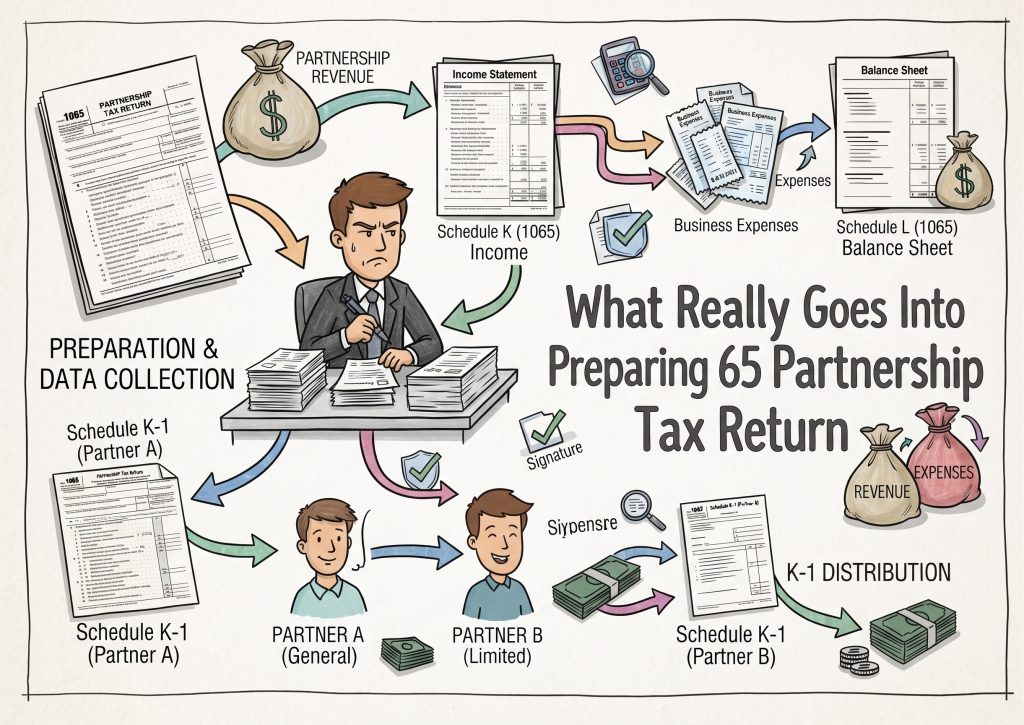
Every tax season, BACH files a Form 1065 partnership return — and every year, we’re reminded of just how much work sits behind that single filing. For a real estate partnership with multiple properties and multiple members, “preparing the tax return” is never a one-step task. It’s closer to a full audit of an entire year’s financial activity, property by property and member by member.
Why a 1065 Is More Complex Than It Looks
A 1065 return doesn’t just report the partnership’s overall income — it has to allocate that income, deductions, and credits accurately across every partner, and it has to reflect the financial reality of each individual property inside the portfolio. For a fund with as many moving parts as BACH, that means the return is only as good as the numbers feeding into it from every single property and every single member’s capital account.
That’s why our process isn’t “check the numbers.” It’s checking, double-checking, and triple-checking — because on a document like this, there’s no room for a rounding error to slip through.
Property by Property
Before anything gets near the actual tax filing, our team works through each property individually: confirming income, verifying expenses are categorized correctly, reconciling depreciation schedules, and making sure capital improvements versus repairs are treated properly. One property’s numbers being off doesn’t just affect that property — it ripples into the partnership totals and, ultimately, into every member’s K-1.
This is where the work we put in on monthly accounting all year pays for itself. Because our books are reconciled every month rather than pieced together at year-end, our tax team is verifying accurate numbers instead of reconstructing them under deadline pressure.
Member by Member
Once the property-level numbers are confirmed, the next layer of review is making sure each member’s allocation is correct — their share of income, their distributions, their capital account activity, all of it tied back to their specific ownership stake. Every member is trusting that their K-1 accurately reflects their piece of the partnership, and we treat that trust as something to be earned every year, not assumed.
Why We Insist on 100% Accuracy
There’s no acceptable margin of error when it comes to tax filings that affect real people’s personal returns. An inaccurate K-1 doesn’t just create a headache for BACH — it creates a headache for every member who has to file their own taxes based on what we send them. That’s why our review process is intentionally repetitive. We would rather spend the extra hours checking a number three times than send an member a figure we’re not completely confident in.
The Result of All That Checking
It’s not the most visible part of what we do, but it might be one of the most important. A clean, accurate 1065 filing is the product of a full year of disciplined financial operations — from monthly reconciliations to careful distribution tracking — all converging into one document that has to be right.
We’re also building tools to make this kind of transparency easier for members to see year-round — read about the BACH member app we’re currently developing.
